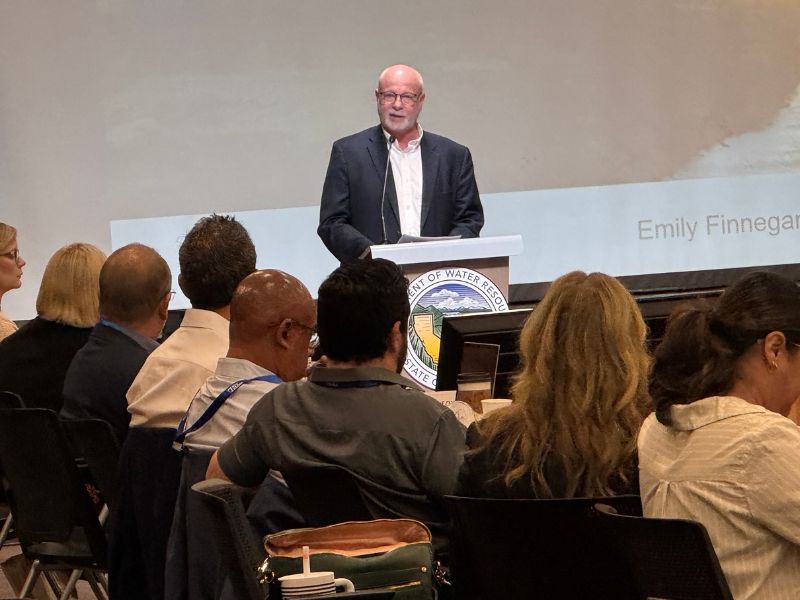
At the California Water Plan 2028 Advisory Committee meeting on August 26, 2026, Southern California Water Coalition Executive Director Charley Wilson urged action and urgency: California’s outdated water infrastructure is driving toward critical collapse, and without immediate action, the state won’t meet its 2040 reliability needs
Wilson’s Remarks to Committee:
Thank you. I am Charles Wilson, here for the Southern California Water Coalition.
I want to speak directly to the reality we’re facing.
Nature is not waiting on our decision making process. Our historic water system is outdated, over stressed, and driving toward critical collapse. And unless this Water Plan confronts that head on, California will not meet its 2040 reliability needs.
This Plan cannot be another document that describes the problem. It has to drive to the most cost efficient, technologically available, and actually deliverable water supply adjustments we can make—starting now.
The Existing System: We Are Out of Time
DWR’s own studies show the truth: Large portions of the San Joaquin Valley are water supply constrained even with existing infrastructure and contracted supplies.
That is not a theoretical concern. That is a system failing in real time.
We need DWR to break down the constraints—hydrology, storage, infrastructure, water rights, contract limits, environmental requirements, operating criteria—and quantify their actual impact.
Then we need accountability:
What reliability are these requirements costing, and what measurable environmental outcomes are they producing?
If better science, forecasting, monitoring, habitat improvements, technology, or adaptive management can maintain environmental performance while increasing reliability, the Water Plan must say so clearly.
New Projects: A System Designed for Stalemate Cannot Deliver 2040 Reliability
Let’s be honest: We have built a permitting system designed for stalemate.
California can identify storage, recycling, stormwater, recharge, conveyance, desalination—but none of it matters if projects cannot get through permitting and construction in time.
Sites Reservoir proved both sides of the story:
- Yes, environmental review can be streamlined without weakening protections.
- But the rest of the permitting system still forces projects through sequential, duplicative, slow moving processes.
That is not a system capable of delivering water. That is a system capable of delaying water.
We need reforms that become standard practice:
- Early interagency coordination
- Concurrent review
- Clear decision criteria
- Predictable timelines
- Site specific science
- Performance based standards
- Adaptive management
Without these reforms, the Water Plan’s supply projections are not credible.
Our Ask: Put Real Accountability Into the Water Plan
We are asking DWR to include one essential deliverable:
A Regulatory and Operational Constraints Assessment.
It must answer two questions:
- How much additional reliability is locked inside the existing system?
- What must change—specifically—to make new projects deliverable by 2040?
Because planning water is easy. Delivering water is hard. And nature is not waiting.
We should all be challenged with the same sense of urgency. California must reform a system that has been designed for stalemate and replace it with one designed for delivery.
Thank you.